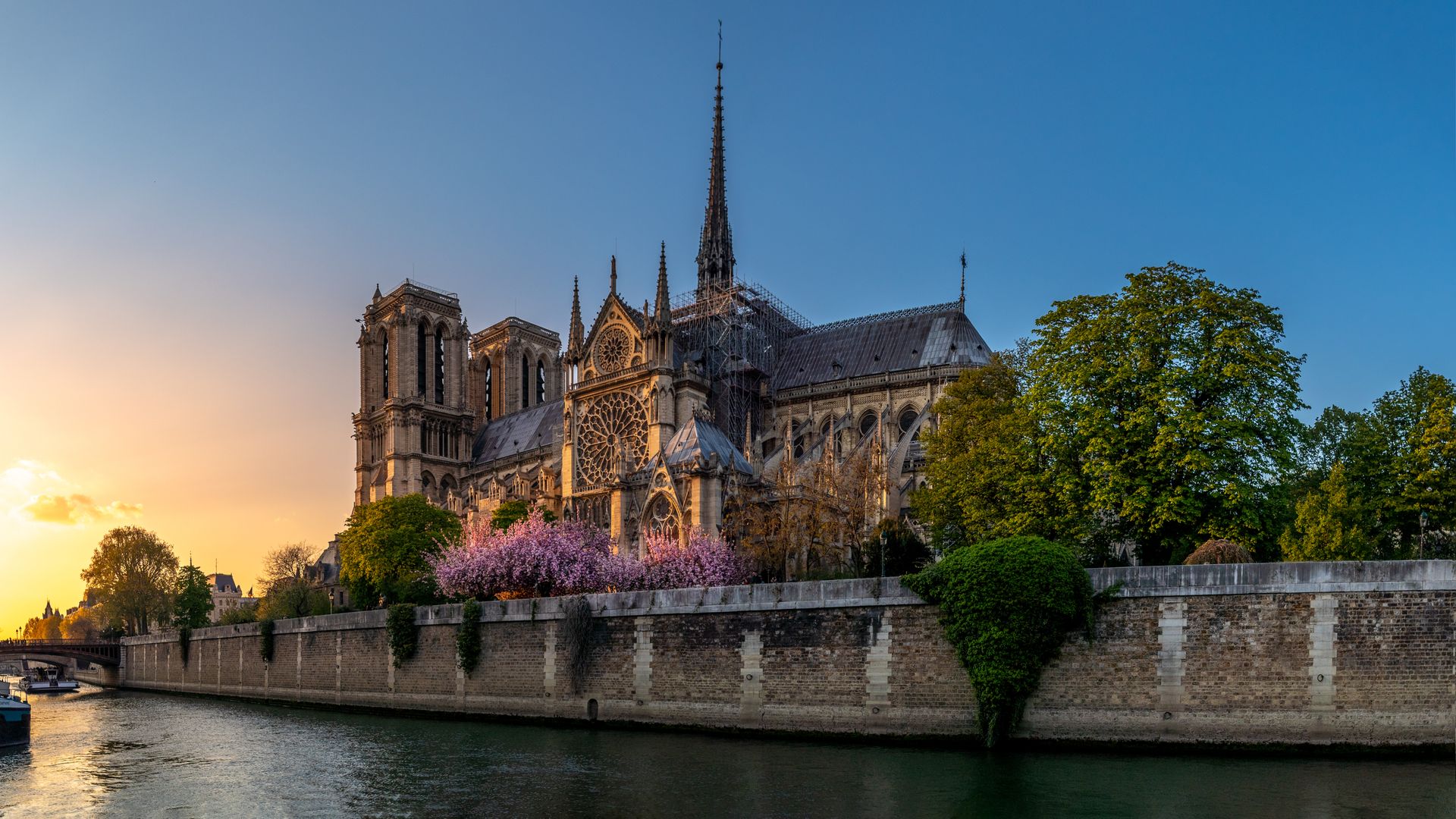
Notre-Dame and the two river islands, Place des Vosges and the Hôtel de Ville, the lower Marais and its Jewish quarter. The 4th is the city's medieval heart — where almost every Paris story starts.
The 4th packs more history into a few hundred metres than almost anywhere on earth. A hand-picked selection of guided walks, island tours and tastings, most with free cancellation.
A guided walk around the island where Paris was born — the exterior of Notre-Dame, the dazzling stained glass of Sainte-Chapelle and the Conciergerie — often paired with a Seine cruise.
Pre-reserved tickets and a guide for two Gothic masterpieces a few steps west of Notre-Dame — the jewel-box chapel of Saint Louis and the medieval royal palace turned revolutionary prison.
Eat your way through the lower Marais and Rue des Rosiers — falafel, cheese, pastries and the city's most famous Jewish quarter, with tastings as you go.
Mansions, hidden courtyards and the grandeur of Place des Vosges — a guided stroll through the lower Marais, its history and its boutiques.
The islands are at their best from the water. Glide beneath the 4th's historic bridges past Notre-Dame, the Île Saint-Louis and the Louvre on a classic sightseeing cruise.
Timed entries and multi-day passes for the great collections nearby — the Louvre, the Orsay and more, all an easy walk or short ride from the islands.
No other corner of Paris feels quite like the 4th: two inhabited islands in the middle of the Seine, the grandest square in the city, and the medieval lanes of the Marais and its Jewish quarter.
A 17th-century island village frozen in time — one main street of ice-cream shops, galleries and hôtels particuliers, ringed by the most romantic quays in Paris.
The oldest planned square in Paris (1612), a perfect arcaded rectangle of rose-brick pavilions around a garden — with Victor Hugo's house in one corner.
The heart of historic Jewish Paris — falafel counters, delis and bakeries threading the liveliest little street in the Marais.
Walk the UNESCO-listed riverbanks and the Pont Marie and Pont Louis-Philippe — booksellers, sunset views and the Seine at its most cinematic.
The great BHV Marais department store, the antique dealers of the Village Saint-Paul and the boutiques of Rue Saint-Antoine and Rue François Miron.
Renzo Piano and Richard Rogers's radical "inside-out" landmark presides over a sloping piazza. Note: the Centre Pompidou is closed for renovation until 2030 — admire it from outside for now.
From the most famous ice cream in France to a Michelin-starred Ducasse bistro and the best falafel in Paris, the islands and the Marais are a feast. A few addresses to plan around.
The most celebrated glacier in France, made on the Île Saint-Louis since 1954. Join the queue for intense fruit sorbets and rich, small-batch ice creams.
The legendary green-fronted falafel counter of the Pletzl — generous, garlicky and worth the line. The benchmark by which all Marais falafel is judged.
A jewel of a 1912 bistro, now under Alain Ducasse and Michelin-starred — classic dishes (cassoulet, soufflé) served in a gleaming Belle-Époque room.
A glorious Belle-Époque brasserie under a stained-glass dome, serving choucroute, oysters and seafood platters since 1864 — pure old-Paris theatre.
A warm Marais bistro devoted to Burgundy — beef bourguignon, escargots and a serious wine list, on a pretty medieval street near Saint-Gervais.
A beloved, mismatched-armchairs tea room famous for towering meringue tarts and weekend brunch — the cosiest stop in the Marais.
A cathedral, two islands and the grandest square in the city — the landmarks worth building your day around.
The Gothic masterpiece on the Île de la Cité, magnificently reopened in December 2024. Entry is free; reserve a timed slot online to skip the longest queues. The bell towers are a separate paid visit.
A serene 17th-century island of elegant townhouses, artisan shops and Berthillon ice cream, wrapped by the loveliest quays in the city. Made for an aimless wander.
The oldest planned square in Paris, a symmetrical masterpiece of arcades and rose-brick pavilions around a leafy garden — and a perfect picnic spot.
The apartment where the author of Les Misérables lived, in a corner of Place des Vosges. The permanent collection is free — a charming literary detour.
Paris's spectacular neo-Renaissance city hall, fronting a grand pedestrian square that hosts seasonal events. Free guided tours and exhibitions run regularly.
France's moving Holocaust memorial and museum in the Marais, with the Wall of Names and a permanent exhibition. Free entry; a place for quiet reflection.
Every monument, island, museum and table of the 4th on one interactive map. Filter by category, or click a place to locate it and open its links.
Paris is divided into 20 arrondissements that spiral outward clockwise from the centre, like a snail. The lower the number, the more central — and the 4th is as central as it gets, straddling the Seine on the Right Bank and the two islands at the very middle of the city.
It is compact and gloriously walkable: Notre-Dame, the islands, the Marais and Place des Vosges are all within twenty minutes of one another on foot. The Métro serves every edge, and the giant Châtelet–Les Halles RER hub sits on the western border.
Since 2025 the system has been simplified: paper tickets are gone, replaced by the contactless Navigo Easy card or your phone. A single Métro/RER ticket is now a flat fare, and a day pass quickly pays for itself if you ride often.
For door-to-door directions, the Bonjour RATP and Citymapper apps are the most reliable companions.
At the very centre of Paris, the 75004 is one of the easiest places to reach — and a joy to explore on foot. Here are the essentials.
A few practical essentials to make your visit to the 4th arrondissement smooth and stress-free.
Spring and early autumn are loveliest. For Notre-Dame, early morning or evening sees the shortest waits; the islands are magical at dusk when the day-trippers leave.
Reserve a free timed slot for Notre-Dame and pre-book Sainte-Chapelle and Conciergerie tickets in season. Place des Vosges, the Maison de Victor Hugo and the Shoah memorial are free.
Cards are accepted almost everywhere (a little cash helps at Berthillon and falafel counters). Service is included by law; rounding up for great service is appreciated, never expected.
Falafel on Rue des Rosiers for lunch, a Berthillon cone on the island, and a classic brasserie or Marais bistro for dinner. Many Marais spots stay open on Sundays.
Notre-Dame opens early; most museums close on Mondays (some on Tuesdays). Lunch is 12–2:30 pm, dinner from 7:30 pm. The Jewish quarter is quieter on Saturdays.
Tap water is safe and free in restaurants (une carafe d'eau). Emergency number is 112. Dress modestly (shoulders and knees covered) to enter Notre-Dame.
Compare stays, tours and experiences across the platforms travellers know best.
Each Paris arrondissement has its own guide. Hover the map to reveal a district's name, then click to open its dedicated site — you are currently in the 4th.
Visit75004.com is featured on GlobalVisitList.com — The List traces the "visit phenomenon" since the early days of the Internet, when some destinations from California picked up the expression.
Soon adopted by the Visitors Bureaus (VBs) of the most iconic destinations like Brescia, Copenhagen, London, Monaco or Singapore.
"Visit" has become a touch of glamour for over a thousand tourist websites.
It's something unique. Soon it will be considered as chic as owning a "crown jewel" or a "Van Gogh" painting.